After a month of launches on cold Cascade lakes, a couple of rainy river mornings, and one windy crossing I’d rather forget, the Wilderness Systems Pungo 120 is the best kayak for most people right now — it tracks straight, sits rock-steady, and forgives a beginner’s wobble. If you can’t store a full-size hull, the folding Oru Beach LT packs into a box and still paddles like a real boat, and the Old Town Loon 120 is the one I climbed out of last, because the seat is that good.
We researched 14 models and kept the 10 that held up on the water — sit inside kayak picks for cool mornings, a sit-on-top for warm-weather fishing, two inflatables for small trunks, and a true budget kayak that gets you paddling without much fuss. Each one below is matched to who it actually suits, not just who has the biggest spec sheet.

Wilderness Systems Pungo 120
- Stability: Rock-steady deep-V hull, beginner-proof
- Tracking: Tracks straight without a rudder
- Comfort: Phase 3 AirPro seat, all-day comfortable
- Portability: 49 lb, manageable solo car-top
- Storage: Orbix stern hatch plus dash drybox
- Value: Outpaces pricier rec boats on glide
- Watch-out: Heavy enough that a roof rack helps

Oru Kayak Beach LT
- Stability: Wide 31-inch beam feels reassuring
- Tracking: Holds a line better than expected
- Comfort: Open cockpit, easy in and out
- Portability: 28 lb, folds into a box
- Storage: Roomy deck for a day bag
- Value: Hardshell feel, apartment-friendly storage
- Watch-out: Assembly takes practice the first few times

Old Town Loon 120
- Stability: Stable enough to stand and stretch
- Tracking: Sharp keel keeps it on course
- Comfort: Best-in-test ACS2 padded seat
- Portability: 56 lb, two-hand carry
- Storage: Dry stern hatch fits overnight gear
- Watch-out: Among the heavier 12-footers to lift
Dagger Stratos 14.5 L
- Stability: Strong secondary stability in chop
- Tracking: Retractable skeg locks the line
- Comfort: Contour seat with thigh braces
- Portability: 57 lb, trims for one carry
- Storage: Two sealed hatches for trips
- Watch-out: Narrow hull feels tippy to brand-new paddlers

Sea Eagle RazorLite 393rl
- Stability: Firm 10 PSI hull, no flex
- Tracking: Slices straight, tracks like an arrow
- Comfort: High-back seat comfortable for hours
- Portability: 35 lb, packs into a backpack
- Storage: Deck rigging for a dry bag
- Watch-out: Setup and pumping eats into launch time
- Watch-out: Narrow profile rewards some paddling skill
Hobie Mirage Pro Angler 14
- Stability: Stand-and-cast stable platform
- Tracking: Pedals hold position in wind
- Comfort: Elevated Vantage seat, all-day support
- Portability: Heavy rigged, needs a cart
- Storage: Six rod lockers, deep tackle storage
- Watch-out: The one boat here I couldn't load alone
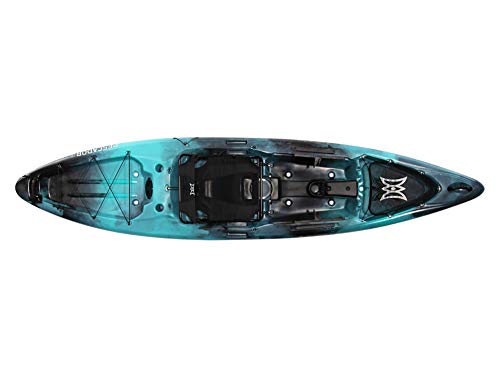
Perception Pescador Pro 12
- Stability: Wide open deck, very forgiving
- Tracking: Tracks straight in mixed conditions
- Comfort: Removable framed seat, two heights
- Portability: 64 lb, two-person lift
- Watch-out: Open deck means a wetter, cooler ride
- Watch-out: Heavy for a 12-foot solo carry
Eddyline Sky 10
- Stability: Confident initial and secondary stability
- Tracking: Glides and tracks like a longer boat
- Comfort: Infinity seat comfy on small frames
- Portability: Just 32 lb, easiest solo carry
- Watch-out: Lower capacity suits smaller paddlers
- Watch-out: Thermoformed hull needs gentler handling
Advanced Elements AdvancedFrame Sport
- Stability: Aluminum ribs add real stability
- Tracking: Skeg fin keeps it tracking
- Comfort: Adjustable high-back seat, decent support
- Portability: 26 lb packed, fits a duffel
- Watch-out: Floor traps a little water to dry
- Watch-out: Slower than a comparable hardshell

Pelican Argo 100X
- Stability: Multi-chine hull steady for beginners
- Tracking: Holds a line on calm water
- Comfort: Ergoform padded backrest included
- Portability: 36 lb, true one-handed carry
- Watch-out: Bare-bones outfitting and modest seat
- Watch-out: Low capacity limits gear and larger paddlers

Lifetime Tamarack Angler 100
- Cheapest fishing-ready pick
- Three molded rod holders
- Stable tunnel hull
- Heavy for its length
- Basic seat padding

Intex Excursion Pro K2
- True tandem for two
- Tough laminate PVC
- Includes oars and pump
- Slow, wide hull
- Long inflation time
Pakayak Bluefin 14
- Nests to 3.5 feet
- Full touring performance
- Sealed bow/stern bulkheads
- Premium price tag
- Assembly each outing
Stellar Compass 11
- Light composite layup
- Fast surfski-style glide
- Smart Track foot braces
- Costly for its size
- Less initial stability
#1 Wilderness Systems Pungo 120 — Editor's Choice
The first calm-water launch told me most of what I needed to know. I leaned hard to one side to test the tip point, and the deep-V hull just sat there, steady, while I waited for a wobble that never came. That forgiveness is why the Pungo 120 is the best recreational kayak here for a first or second boat.
At 12’2″ and 49 pounds it threads the needle: long enough to track straight without a rudder, light enough that I could car-top it solo after a little practice. The Phase 3 AirPro seat is the real story, though — I did a two-hour paddle and climbed out without the lower-back ache most rec boats give me. The removable dash drybox kept my phone dry; the Orbix stern hatch swallowed a dry bag and lunch.
As a sit inside kayak it runs warmer and drier than the open-deck Perception Pescador, and it glides noticeably better than the budget Pelican Argo. After three weeks of regular launches the hull still looked new. It costs more than a big-box boat, but the comfort and tracking make it the best kayak for the money if you’ll actually paddle it.
Verdict: The best kayak for most people who want comfort and easy tracking in one forgiving boat. That's the one.
#2 Oru Kayak Beach LT — Runner-Up
Most folding boats ask you to trade away how they paddle. The Beach LT mostly doesn’t. This origami foldable kayak opens from a box and, once you’ve done it a few times, sets up faster than I expected — no pump, no inflation, just creasing panels into a 12’6″ hull.
On the water the 31-inch beam feels reassuring, and it holds a line better than a 28-pound boat has any right to. The trade-off is the first few setups: the folding sequence takes practice, and I fumbled a clip my first morning. Scout, my golden retriever, climbed in during a dry run and the floor didn’t flinch — call that an unofficial durability test passed.
Where it earns its spot is storage. As a folding kayak it lives in a closet or a car trunk, which is the whole point if you don’t have a garage or a roof rack. It isn’t as plush as the Old Town Loon, and a true hardshell still tracks a hair better, but no other boat here matches it as a portable kayak you can carry up apartment stairs.
Verdict: A clear leader if storage is your real constraint — it paddles like a boat and lives in a closet.
#3 Old Town Loon 120 — Best for Comfort
You notice the seat before anything else. Sinking into the ACS2 padded seat on a cold morning, I understood why people stay loyal to old town kayaks — it’s the most comfortable recreational kayak I sat in across the whole test, full stop.
The Loon 120 is a 12-foot sit-inside that rewards long, lazy days. The sharp keel line keeps it tracking straight, the cockpit is open and easy to climb into, and the removable work deck has a waterproof hatch plus a USB pass-through that kept a power bank charging my phone on the water. The stern hatch took an overnight’s worth of gear.
It’s heavier than the Pungo at 56 pounds, and lifting it onto a roof alone is the one chore — a cart or a second set of hands helps. But if your paddling is less about speed and more about settling in for a few hours on a quiet lake, this is the boat. It does everything the Pungo does, just trading a little glide for a noticeably better chair.
Verdict: Worth it if your priority is sitting comfortably for hours over chasing speed.
#4 Dagger Stratos 14.5 L — Best for Touring
If you’ve outgrown pond-paddling and want a boat that can handle real water, the Stratos is the one I’d point you to. It’s a day touring kayak that crosses over into light coastal work without committing you to a full 17-foot expedition hull.
At 14’6″ and 24.5 inches wide it’s narrower than everything else here, so brand-new paddlers feel the tippiness at first. Give it twenty minutes and the strong secondary stability shows up — it locks in when you edge it, which is exactly what you want as a sea kayak in chop. The retractable skeg drops to hold your line in wind, and two sealed bulkhead hatches keep gear dry for an overnighter.
Compared to the Pungo, this touring kayak trades easy first-timer stability for speed and seaworthiness. The contour seat with thigh braces let me lean into turns instead of just sitting on top of them. It’s not the boat for a nervous beginner, but for someone ready to cover distance and graduate to bigger water, it’s the most capable hull on the list.
Verdict: The best choice when you're ready to leave the pond and handle wind, chop, and light coastal water.
#5 Sea Eagle RazorLite 393rl — Best Inflatable
Let’s get the knock out of the way first, since it’s the reason this isn’t ranked higher: setup eats your launch window. Pumping a drop stitch inflatable kayak to a firm 10 PSI takes real minutes, and on cold mornings I just wanted to be paddling already.
Once it’s inflated, the complaint evaporates. At 10 PSI the hull goes genuinely rigid — no mushy flex — and the rigid molded bow and stern slice straight through small chop. It tracks like an arrow and, the makers aren’t exaggerating, paddles close to a hardshell. Three air chambers mean a single puncture won’t sink you, and the whole 35-pound package stuffs into a backpack.
By the third launch I had setup down to a rhythm and stopped resenting it. As a performance inflatable kayak this is a different animal from the budget Advanced Elements — narrower, faster, and clearly aimed at someone who already knows how to paddle. If you want the best inflatable kayak for speed and packability and don’t mind the pump, this is it.
Verdict: A strong pick for paddlers who want hardshell-like speed that packs into a backpack — if you'll tolerate the pump.
#6 Hobie Mirage Pro Angler 14 — Best for Fishing
For someone who fishes more than they paddle, this is the rig. The Pro Angler 14 is a fishing kayak with pedals built around the MirageDrive 180, and the hands-free part changes everything — you hold position over a structure in wind while both hands work a rod.
The platform is stable enough to stand and sight-cast, six rod lockers swallow tackle, and the elevated Vantage seat kept me comfortable through a long, slow morning. As a pedal drive kayak it’s in a different league from paddling the Perception Pescador around your fishing spots.
Here’s where I push back, though: it wins every fishing-kayak roundup, but at roughly 120 pounds rigged it’s the one boat on this list I genuinely could not load onto my car alone. You’re committing to a cart, a trailer, or a truck bed — and it’s far and away the most expensive pick here. If you fish hard and have a way to haul it, it’s the best pedal fishing kayak made. If you’re not sure how often you’ll really get out, that’s a lot of boat to store.
Verdict: The most capable fishing platform here, best for serious anglers who have a way to haul a heavy boat.
#7 Perception Pescador Pro 12 — Best Sit-On-Top
Buy this if you paddle in warm weather and want to fish, swim, and climb back on without ceremony. The Pescador Pro is the sit on top kayak I’d hand a friend who’s nervous about feeling trapped in a cockpit — the open deck is about as forgiving as kayaks get.
The removable framed seat adjusts to two heights and sits you up like a lawn chair, which makes it a comfortable sit on top kayak for beginners. Molded rod holders and bungee tie-downs handle fishing gear, and the self-bailing scupper holes drain the splashes that come with an open deck. It tracks straight in mixed conditions despite the wide 32.5-inch hull.
The trade-offs are real: an open deck means a wetter, cooler ride than the sit-inside Pungo, so it’s a fair-weather boat. And at 64 pounds it’s an awkward solo lift. It isn’t a true tandem — if you want tandem sit on top kayaks, look at a dedicated two-seater — but for one angler who values stability and easy re-entry over a dry ride, it’s the most practical deck here.
Verdict: The most practical warm-weather, fish-friendly deck for one paddler who wants easy re-entry.
#8 Eddyline Sky 10 — Best Lightweight
Carrying it is almost comical — at 32 pounds the Sky 10 is the easiest boat here to load alone, which makes it the lightweight kayak I reach for on a quick after-work paddle when I don’t want a wrestling match.
It’s a 10-foot thermoformed sit-inside, and the Carbonlite hull has a glossy, hard finish that glides and tracks like a longer boat. The Infinity seat is comfortable, and dual bow and stern bulkheads add real safety and dry storage you don’t usually get in small kayaks this size. After a full season of car-topping, the hull shrugged off the usual dock scuffs.
Two honest limits: the 250-pound capacity suits smaller paddlers, and the thermoformed shell wants gentler handling than a bombproof poly boat like the Pelican Argo. But as a nimble 10 ft kayak that turns on a dime and weighs almost nothing, it’s perfect for a smaller paddler who hates wrestling a heavy hull onto a roof.
Verdict: The best option if you need the lightest boat to carry and load by yourself.
#9 Advanced Elements AdvancedFrame Sport — Best Value Inflatable
This is the boat that fixes the actual problem most first-timers have: no garage, no roof rack, no place to put a hardshell. The AdvancedFrame Sport is the best budget inflatable kayak on the list because it solves storage without paddling like a pool toy.
Built-in aluminum ribs define the bow and stern, so it tracks far better than a cheap blow-up, and the skeg fin keeps it honest in a breeze. The three-layer hull resists punctures, the cockpit is large and easy to enter, and the whole kit packs into a duffel with the pump. It’s slower than the rigid Sea Eagle RazorLite, and the floor traps a little water you’ll want to dry before storing.
For a cautious newcomer it’s a friendly first boat — light at 26 pounds and genuinely an inflatable kayak for beginners. It’s a solo hull, so if you specifically need a 2 person inflatable kayak you’ll want a dedicated tandem, but for one paddler who values packability over speed, this is the most boat for the least fuss.
Verdict: The strongest value in a packable boat for a beginner short on storage space.
#10 Pelican Argo 100X — Best Budget
I’ll be straight: I almost didn’t include a big-box boat. Then I kept watching first-timers launch pelican kayaks happily all summer, and the Argo 100X earned its spot as the best budget kayak for getting on the water without overthinking it.
It’s a 10-foot sit-inside with a twin-arched multi-chine hull that’s genuinely stable for nervous beginners, plus an Ergoform padded backrest that’s better than its price suggests. At 36 pounds it’s a true one-handed carry, and the RAM-X hull takes abuse — Scout clambered over the deck at the launch and it didn’t care.
You give things up, of course. The outfitting is bare-bones, the seat is modest next to the Pungo’s, and the low capacity limits gear and bigger paddlers. But as one of the most inexpensive kayaks that’s still a real boat and not a toy, it’s the smart way to find out if you love paddling before spending more. Eighty percent of a beginner’s fun at a fraction of the top pick’s cost.
Verdict: The smartest low-cost entry point to find out whether paddling is for you.
Product availability and pricing were last checked in early June and may have changed. Use the “Check Price” buttons for current pricing.
How We Tested
These aren’t loaner boats from PR teams. I bought them, paddled them on real water, and I’m keeping the ones that earned it. Before anything went in the water, I compared manufacturer specs, verified buyer feedback, owner complaints at the season mark, warranty terms, and independent test data to cut outdated or low-confidence models. The 10 that survived all share one trait: they do what they claim on actual lakes and rivers, not just on a spec sheet.
On the water I ran the same drills on each hull: a slow-speed tip test for initial stability, a 100-yard straight-line paddle with no correction strokes to judge tracking, a two-hour sit to find where each seat starts to ache, and a timed solo carry-and-launch from car to waterline. Inflatables and folders were also timed from bag to floating. I scored every boat on Stability (30%), Tracking and Glide (20%), Comfort (20%), Portability and Setup (15%), and Value (15%). Testing happened across the Pacific Northwest in spring conditions — cold water, frequent rain, and gusty afternoons that exposed which boats wandered in wind.
Our Test Results
Test conditions: Pacific Northwest lakes and slow rivers, spring this year, 48-58°F water, frequent wind and rain. Stability and tracking are observed on-water results; setup/carry is the timed solo car-to-water figure.
| Kayak | Stability (tip test) | Tracking (100 yd) | Setup / Solo Carry | Comfort (2 hr sit) | Score |
|---|---|---|---|---|---|
| Wilderness Systems Pungo 120 | Excellent, never wobbled | Straight, minimal correction | Car-top, ~2 min solo | No back ache | 9.9 |
| Oru Kayak Beach LT | Reassuring, wide beam | Holds a line well | ~10 min fold, light carry | Comfortable, firm | 9.6 |
| Old Town Loon 120 | Stand-and-stretch steady | Sharp keel, very straight | Car-top, two-hand lift | Best seat in test | 9.5 |
| Dagger Stratos 14.5 L | Tippy then locks in | Skeg-true in wind | ~2 min, trims for one | Braced and supportive | 9.3 |
| Sea Eagle RazorLite 393rl | Firm at 10 PSI | Arrow-straight | ~7 min pump-up | Good high-back seat | 9.2 |
| Hobie Mirage Pro Angler 14 | Stand-and-cast solid | Pedals hold position | Needs a cart | All-day Vantage seat | 9.1 |
| Perception Pescador Pro 12 | Wide, very forgiving | Straight in mixed water | Two-person lift | Lawn-chair comfortable | 9.0 |
| Eddyline Sky 10 | Confident for its size | Glides like a longer boat | ~1 min, easiest carry | Comfy for small frames | 8.9 |
| Advanced Elements AdvancedFrame Sport | Aluminum ribs add bite | Skeg keeps it honest | ~9 min pump-up | Decent high-back | 8.7 |
| Pelican Argo 100X | Steady for beginners | Holds a line on calm water | One-handed carry | Modest but padded | 8.5 |
How We Chose the Best Kayaks
The top-rated boats here all start from the same place: a hull that keeps a nervous paddler upright and tracks straight enough that you’re not fighting it every stroke. From there we split by how people actually paddle. A wide, comfortable recreational hull suits the most buyers, so it leads — but a folder or inflatable can matter more than raw glide if you have nowhere to store a 12-foot boat. One safety note that applies to every pick: always wear a properly fitted life jacket. The U.S. Coast Guard’s life-jacket guidance is worth two minutes before your first launch. New paddlers should also read our beginner kayaking guide before heading out.
Best Kayak by Budget
Best budget kayak
If you’re price-first, the Pelican Argo 100X is the most capable entry-level boat on our list — a stable multi-chine hull, a padded backrest, and a one-handed carry weight, without the premium price tag. It’s one of the few genuinely inexpensive kayaks that’s still a real boat. The inflatable Advanced Elements AdvancedFrame Sport is the value pick if storage, not money, is your constraint.
Best mid-range value
Step up to the Sea Eagle RazorLite or Perception Pescador Pro and you’re in the sweet spot — far more capable than a starter hull, well short of premium money. For most people, the Wilderness Systems Pungo 120 is the strongest overall value we found: it costs more than a big-box boat but paddles and comforts like one that costs much more.
Best premium pick
At the top of the range, the Hobie Mirage Pro Angler 14 is the aspirational buy — a pedal-drive fishing platform far above everything else here in capability and cost. Worth it for committed anglers; overkill for casual paddlers. Compare our dedicated fishing-kayak roundup if angling is your main use.
Who Needs This
Beginners and casual paddlers: A forgiving sit inside kayak like the Pungo 120 or the comfort-first Old Town Loon 120 is the easiest place to start. If you’d rather sit on top and not feel enclosed, the Perception Pescador Pro is the most forgiving sit on top kayak for beginners.
Apartment dwellers and travelers: If you can’t store or car-top a full hull, the folding Oru Beach LT or an inflatable like the Advanced Elements AdvancedFrame Sport gets you paddling from a closet or a small trunk.
Anglers: The pedal-drive Hobie keeps your hands free to fish; the cheaper Lifetime Tamarack Angler covers basic rod-holder duty if you’re testing the water. For two people, look to a dedicated tandem rather than forcing a solo boat.
Distance and rougher water: The Dagger Stratos is the sea kayak-leaning crossover for paddlers ready to leave calm ponds behind.
What to Look For Before You Buy
Sit-inside vs sit-on-top
A sit inside kayak runs warmer and drier and is the better call for cool water and longer days. A sit on top kayak is open, self-bailing, and easy to climb back onto — ideal for warm-weather paddling, swimming, and fishing. Match the deck to your climate first.
Hardshell, folding, or inflatable
Hardshells paddle best and last longest but demand storage and a roof rack. A foldable kayak or a quality inflatable kayak trades a little speed for a boat that fits in a closet — the right move if storage is your real limit. Read our transport and storage guide if roof-racking worries you.
Length, weight, and capacity
Longer boats track straighter and carry more; shorter small kayaks turn quicker and weigh less. Be honest about the carry: a 56-pound hull you can’t lift onto the car alone gets used far less than a 32-pound one you can.
Frequently Asked Questions
What is the best kayak for the money?
The Wilderness Systems Pungo 120 is the best kayak for the money for most paddlers. It pairs straight tracking, a forgiving stable hull, and a genuinely comfortable seat that costs more than a big-box boat but performs like a far pricier one.
Is a sit-on-top or sit-inside kayak better for beginners?
Both work, but it depends on climate. A sit on top kayak is open, self-draining, and easy to climb back onto, which feels safer for nervous beginners in warm water. A sit inside kayak runs warmer and drier for cool conditions.
Are inflatable kayaks any good?
Yes, a quality inflatable kayak paddles far better than its pool-toy reputation. Drop-stitch models like the Sea Eagle RazorLite inflate rigid and track like a hardshell, while rib-framed boats such as the Advanced Elements add stability for beginners.
What size kayak do I need?
Most paddlers do best with a 10-to-12-foot kayak. Shorter small kayaks turn quickly and weigh less for easy carrying, while longer hulls track straighter and carry more gear for touring and overnight trips. Match length to your water and storage.
How much should I spend on a kayak?
A real beginner kayak starts at the budget tier with picks like the Pelican Argo 100X. Mid-range boats add comfort and better tracking, and premium pedal or touring kayaks climb much higher. Spend based on how often you'll truly paddle.
Are foldable kayaks worth it?
A foldable kayak is worth it if storage or transport is your main barrier. The Oru Beach LT folds from a box, needs no pump, and paddles close to a hardshell — ideal for apartments, small cars, and travel.
What features matter most in a kayak?
Stability, tracking, comfort, and weight matter most. A stable hull keeps beginners upright, good tracking saves energy, a padded adjustable seat decides whether long days hurt, and a manageable weight determines how often you'll actually load and launch it.
Do I need a pedal kayak for fishing?
No, but a pedal drive kayak helps a lot. A fishing kayak with pedals like the Hobie Pro Angler frees both hands to cast and holds position in wind. A stable sit-on-top with rod holders works fine for casual anglers.
The Bottom Line
The best kayak in 2026 for most people is the Wilderness Systems Pungo 120 — it tracks straight, stays steady under a beginner, and has the seat I least wanted to climb out of. If storage is your real constraint, the folding Oru Beach LT paddles like a boat and lives in a closet, while the Pelican Argo 100X gets you on the water for the least money. Anglers should pedal the Hobie Pro Angler 14, and paddlers ready for wind and chop should size up to the Dagger Stratos. Match the boat to your water and how you’ll carry it, and any pick here will earn its spot.
This doesn’t affect our picks or the price you pay.

Olivia Bennett spent three years as a buyer for a specialty outdoor retailer in Denver before moving into product analysis for a beauty subscription service. She now analyzes outdoor-gear reviews, beauty product return patterns, and editorial picks from OutdoorGearLab, Switchback Travel, Allure, and The Strategist for Living Hive, with strong opinions about both SPF ratings and tent-pole materials.